

Crate Expectations
The feeling of discovering music can be faked. The friendship can't.

The Analog Kid
Rush released Signals as I began my sophomore year of high school, and the opening track “Subdivisions” arrived like a letter with my name handwritten on it. For the first time ever, I felt seen. Understood. By a total stranger.
I was living in the Connecticut suburbs, awkward and unathletic, a long way from the popular crowd. Words failed whenever I tried to use them, and I had NO idea what to say at a party, though my odds of getting invited to one were about .875% (that's 7/8, give or take a percent sign, for those keeping track and time). Drummer/lyricist Neil Peart had done his homework when he wrote:
Nowhere is the dreamer
Or the misfit so alone.
What sorcery was this? A man I'd never met, reading my mind through a record sleeve. Was it magic or science? A one-time lightning strike, or something repeatable? I wasn't about to crowdsource the answer from classmates who'd just as soon stuff me into a locker as copy my algebra notes (fun fact: interior locker lighting was never great for reading album credits). No, this was a spiritual journey I'd have to take alone.
The song also included an escape route:
Drawn like moths we drift into the city
The timeless old attraction
Cruising for the action
Lit up like a firefly
Just to feel the living night
So that's what I did. If Rush understood, there must be others.
Of course, there were record stores closer to home, a fact my father would inevitably invoke every Saturday evening when he’d pay me for the yardwork I’d done that day. He’d remind me that it would be cheaper to buy my records locally, save the train fare, and, hell, he’d even offer to drive.
Talk about missing the point.
The point was freedom and possibility. The solitude of a Sunday morning trek on the New Haven Line. Panasonic walkman loaded with fresh AA batteries, Rush cassette inside, and another in my pocket. Grand Central delivered me into a city that cared nothing for my social standing. School dances and the seniors' cars in the parking lot back home played "the approved list" on repeat. The Greenwich Village crates were the draw: more music that might hit me with the same impact as “Subdivisions.” Therapy before I had a therapist. Those crates held everything nobody had voted on yet. I didn't know why they were calling me, but I could hear them.
Bins There, Done That
Raise your hand if you miss the experience of digging through those $3/each mixed, unsorted vinyl crates, then rolling the dice on a trio of complete unknowns. No algorithms to steer me in any particular direction, no advertisements influencing my decisions. My buying choices relied on instinct, mood, and hope.
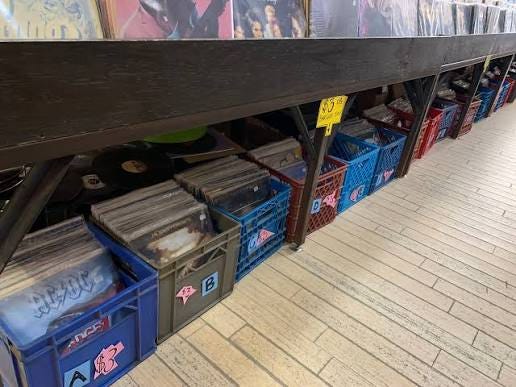
Sometimes, especially early in my collecting days, I got more mileage out of the leftover dollar after selecting three records with the ten bucks Dad had handed me the night before. When I was a high schooler crate digging in Greenwich Village, that buck was spent on a hot dog and a Coke at Gray’s Papaya on the corner of West 8th Street and 6th Avenue before catching the train back home. I’d wolf it down in the seconds it took to walk to the subway, when those new mystery vinyl purchases in the brown paper bag held nothing but pure potential. They were future friends. Confidants. Mentors. Maybe one of them would become my favorite record ever.
Ah, youth.
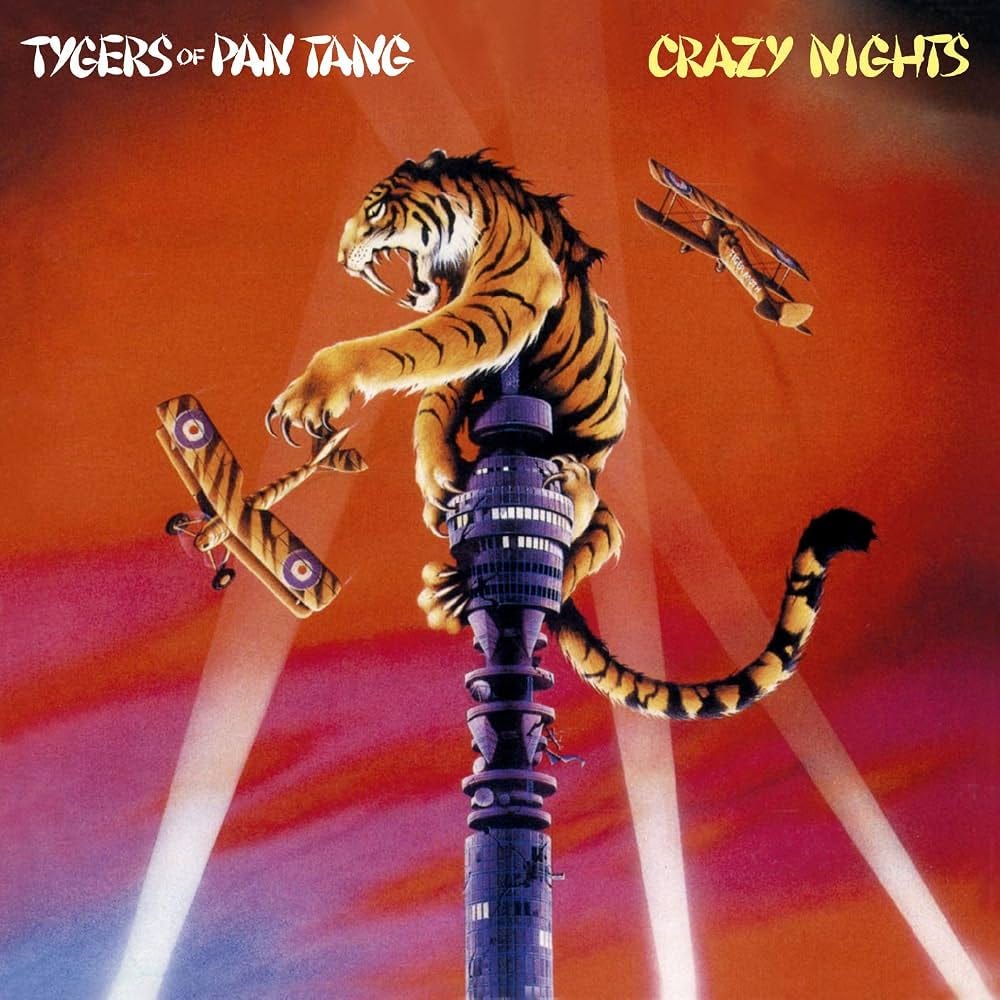
More often than not, the stylus found disappointment. Most of those vinyl acquisitions ranged from meh to mistakes, creating a two-front battle of regrets: my judgment and the Gray's Papaya aftershock. Hot dogs were my kryptonite, so no mystery there. But what was I thinking when I picked up that copy of Tygers of Pan Tang’s Crazy Nights? It wasn’t even one of Rodney Matthews’ better album sleeves.
To be fair to my (and many others’) younger selves, judging a book by its cover was part of the game in the beginning. Over time, through experience and evolving taste, I developed a more refined enthusiast’s eye. Malcolm Gladwell would probably call it “cognitive thin-slicing,” a blink-like set of crate-digging skills that bordered on superhuman. Sailing through crates o’ crap that often included multiple cutouts of Emerson, Lake & Palmer’s Love Beach and endless stacks of Herb Alpert’s Whipped Cream and Other Delights was child’s play. The record store across the street from the movie that starts in 15 minutes? No worries—I could flip the entire shop with seven broken fingers and a raging case of poison ivy before the previews even started.
So why choose one record and pass on fifty others? That was the beauty and purity of it: the decision was entirely yours. One reason, multiple reasons, or no reason at all. An eye-catching cover. An intriguing track title. You recognized the bassist’s name from a better-known session. The producer had the same name as a good friend. You knew nothing, and you rolled anyway. Most of those records remained strangers. A few became acquaintances. And once in a very great while, one became a friend for life.
The Envelope, Please
By the late 80s, the turntables had turned. I lucked into a dream job. I was a label buyer at a music wholesaler (which would later become Alliance Entertainment, or AEC), so now the crates were coming to me. The CD explosion was in full swing, so major and independent labels would create new release books and “one sheets,” which arrived at our office with promotional CDs. The intent of the record labels was to educate the staff about forthcoming releases and reissues, as our company serviced several thousand retail stores in the USA and abroad. For me, that meant access to a lot of music without spending a dime. No trains, hot dogs, or side-eyes from my folks about where I was spending my time or money. The padded manila envelopes all looked the same. Other than the record label's return address, there was nothing to go on. Tear it open and see what’s inside!

A random envelope pull in 1994 revealed a CD by the British band Mother Earth titled The People Tree, on the Acid Jazz label, distributed in the US by Hollywood Records. None of that meant anything to me, but I did note that the album closed with a track called “A Trip Down Brian Lane.” Brian Lane managed Yes through their entire 1970s heyday. I was Mr. All Things Yes. Suddenly, I was transported back to those West 8th Street crate digs. I knew nothing about this band. Four guys on the cover who didn’t look like they were posing for the MTV crowd (good), no drum machines in the credits (increasing interest), and it seemed like they were telling a joke that would land for maybe a few thousand people on Earth.1 One of them happened to be holding the envelope. I could roll the dice without spending a dime, and if I didn’t like what I heard, I’d put it back into the promo pile—it might be better suited for someone else.
I wasn’t expecting to make a new lifelong friend.
Please form your own opinions. If you’d prefer to know a little bit before pressing play on one of the videos I’ve embedded below, the tl;dr on Mother Earth’s The People Tree is that it channels the warm, analog vibe of 60s/70s soul/rock, with echoes of Traffic, Curtis Mayfield, the Small Faces, Brian Auger’s Oblivion Express, Santana, and lovely acoustic passages that invoke Pentangle, Nick Drake, and John Martyn. It contains “Jesse,” the shoulda-been hit. I was blown away on the first spin, mesmerized on the second, and it wasn’t long before The People Tree found its way into my personal Top Twenty albums, ever. Mother Earth’s follow-up, You Have Been Watching, isn’t far behind it, either. The People Tree has been reissued several times, each with a stack of bonus material. The album sold respectably around the world and broke nowhere. The album remains criminally underground here in the States. It has a special place in the Syd Recommendation Hall of Fame: 100% of the people I’ve suggested it to have given it rave reviews.
The People Tree was quickly taped onto a Maxell XLII-S for car listening on BOTH sides of the tape, which tells you how deeply I love the record. Not only did I not want to waste time rewinding, but I also found the music too good for your basic, run-of-the-mill Maxell XLII! It became one of the half-dozen albums that were in heavy rotation in 1994/1995 when I met and began dating the woman I’ve now been married to for nearly three decades. It was the soundtrack to many a late-night escape from some godforsaken company bonding event. It accompanied us to the weddings we wanted to attend and the celebrations of obligation. It’s one of her favorite albums, too. And I’d be remiss if I didn’t mention that both of my daughters who are in their mid-20s would put The People Tree in their personal Top Twenty (if not Top Ten), and they sing along to every word.
Maybe it didn’t break anywhere else in the world, but it sure broke here. Sometimes, you roll the dice on an unknown, and it pays off. Big time.
Let’s be honest about that envelope. It was marketing, albeit dressed in casual clothes. Hollywood Records paid postage to influence a buyer, and the buyer knew it. They put their return address in plain sight. There was no discussion, plan, or campaign: I had no allegiance to the label or the band. Just a personal agenda and overflowing enthusiasm to talk everyone’s ear off about this superb album hiding in plain sight.
Nobody cared.
By the mid-90s, the marketing chain had grown a new link: the Internet, back when it was made of people and promise. The music industry hadn’t yet colonized and gentrified it, so, as a music fan, it was the ultimate discovery playground. The Gibraltar Digest was turning me on to obscure progressive rock from every corner of the globe. On rec.music.phish I found a community’s collected wisdom about a band I'd seen exactly once, though that one show had already rearranged my life. The old magic of the Internet was being written by those using it: listservs, Usenet, mailed HyperCard stacks, and fan pages built on weekends. The fan community's heyday was driven by enthusiasts steering enthusiasts, signed with real names, and auditable as any guy behind any counter. Sure, bands were promoting themselves, but nobody was trying to sell me anything under false pretenses or pretending to be somebody they weren’t.
Mother Earth, though, remained a frustrating mystery. Acid jazz barely penetrated the US market, and the CD singles and B-sides that make a collector’s heart race were hard to source on this side of the ocean. So when I found an early fan-made Mother Earth website, I emailed the webmaster. Was the band still going? Would they ever play the States? Where does a person find the rarities?
I received no reply.
Is That a Real Poncho? Or is That a Sears Poncho?
Thirty-two years after I opened that envelope, the Internet marketing chain has turned counterfeit, and counterfeits mean volume. This past spring, digital chicanery kept popping up like fake Gucci handbag sellers in Washington Square Park, and the musicians noticed. Hell, the entire music industry noticed. And all of it gives me the heebie-jeebies.
Music marketing doesn’t need to be completely bias-free. Just don’t conceal the bias.
Chaotic? Absolutely. Good? Well…
In March, two co-founders of a digital music-promotion agency called Chaotic Good Projects sat for a live Billboard interview at South by Southwest and described using networks of sock-puppet accounts to manufacture enthusiasm for artists at every level of the business. One of them had a name for the service: “trend simulation.” Sounds like a sexy marketing term until you learn it’s a bit like faking an orgasm.
Lane Brown’s New York Magazine reporting widened the narrative. A man who ran a firm called Floodify claims it operated 65,000 dummy accounts posting 50,000 videos a day, with major labels among the clients. Expect to hear more and more about a “product” called clipping: agencies recruit regular people to flood online platforms with organic-looking fragments for a dollar or two per thousand views. The algorithms interpret these content spikes as genuine interest and increase the velocity of recommendations for real humans. And here’s the rub: a properly disclosed ad costs roughly 10X as much as one of these covert versions. Honesty comes at a premium. I wonder if those manila envelopes would’ve been generic back in the day if putting a legit return address on them cost extra.
And It’s Just a Dox of Pain
The band that caught the shrapnel was Geese, the young Brooklyn band having a moment. Musician/writer Eliza McLamb did the heavy lifting: her revealing Substack essay outed Chaotic Good’s client roster, including Geese, and the firm scrubbed its website the day after she published. Wired amplified the brouhaha two weeks later and invoked the word "psyop." Paste fired back with a headline informing everyone they had just discovered digital marketing. Then TMZ photographed Geese’s frontman with Olivia Rodrigo, and the subject changed.
What did we learn? The band hired the firm. No one is arguing that point. What nobody could prove, then or now, is what the money did, whether a single real fan arrived because a paid rent-a-fan told them to. That is the real damage: once the feeling of stumbling onto a band is a line item on an invoice, no band can prove an organic rise again, not even the ones that earned it.
The mistrust has spread past music. When I shared my delight at the videos of overseas fans falling for the United States during the World Cup, the first reaction that came back was: “Those are probably FIFA-bought and placed. Another psyop.”
This entire marketing approach is baffling to me. Even in my earliest Internet marketing campaigns, literally building the Creed fanbase online, fan-by-fan, I was always upfront about who we were (a record label) and what we were doing. I don’t know many relationships built on a lie that went the distance. Fandom is no different.
Blake’s Progress
In late June, James Blake posted a short but powerful Instagram story, denouncing comment sections stuffed with fake fans, YouTube counts purchased, and streaming numbers driven by bot farms. Ultimately, he lamented the bigger creative threat that we can no longer assume a song was made by human beings at all. His summary line for artists: “…there’s not a single part of the system that isn’t faked.” At the same time, he reminds artists that the fakery cuts both ways, so they’re probably doing better than they think. When distrust is total, even the bad news is unreliable.
Boo Tube
Back in early May, YouTube added a “Create” button to the Replace Song tool: four royalty-free AI instrumental tracks, generated on demand, to swap out copyrighted audio that’s triggered a Content ID claim. So if a creator’s video gets flagged (the cooking clip, the concert recap, the baby’s first steps), they’re one button away from making the problem disappear in seconds. And when that message from YouTube threatening takedown or account suspension arrives, it’s a scary moment, so a low-friction fix seems like a gift, right?
As a former major-label executive and current content creator, my position on Content ID hasn’t shifted: it’s a mess. Labels have entire staffs devoted to maintaining Content ID equilibrium to squash bad or unwanted behavior while maximizing revenue, and content creators are often Content ID victims, even when they’re trying to play by the rules. So while I give credit where it’s due for identifying a real frustration, this AI-powered get-out-of-jail-free card is nothing more than a one-click system that trains people to treat music as a generic, hot-swappable background element. It’s conditioning people to devalue musicians, cheapen music, and contribute to the growing AI slop bucket of C+ listening experiences. When YouTube tells a generation of creators that a one-click AI-created soundtrack to their child’s first steps is a perfectly acceptable substitute for “Walk This Way” or “The Blues Walk,” that’s a message about the value of music. A really, really bad one.
Royalty-free means that somewhere a musician isn’t getting paid. And when the thing you needed to train your model on stops getting made, well, it’s like riding a bike and only turning right. You’ll make a circle that gets smaller until you fall down. I wish they’d add another option if AI-generated music is here to stay: licensed tracks that fit the video’s mood, rights cleared, musicians paid. Give the creator the option. Give a musician a chance.
Long Distance Runaround
The phone rang in my office at Virgin Records in 2003, an unrecognized UK number. I’d made the mistake of picking up an anonymous UK-based call once before, only to receive an earful from an artist who’d been dropped from the label years earlier, demanding an accounting audit. Before it went to voicemail, I saw that my assistant Leslie had picked it up. I didn’t hear any yelling, so I returned to the task at hand. Then she poked her head in.
“There’s some British guy on the phone asking for you. Says his name is Matt Deighton from Mother Earth.”
This had to be a joke. Everyone knew about my thing for this band. Somebody was putting me on. I picked up, ready to be a good sport about it, and a pleasant-accented voice asked (if memory serves), “Is this Syd? It’s Matt Deighton calling from the UK. I was in a band called Mother Earth, and years ago, you sent an email to our webmaster. It’s a few years late, but I’m returning your message.”
The voice on the phone belonged to a musician's musician: lead guitarist in Paul Weller's band, collaborator with Squeeze's Chris Difford, the man Oasis rang when Noel Gallagher quit mid-tour in 2000. There's a documentary about his life now. Britain was hip to Matt Deighton. America wasn’t and still isn’t. I’ll rant about that another day.
Six years, give or take, between message and reply. The counterfeit-enthusiasm industry measures response time in milliseconds and sincerity in cost-per-thousand. The real thing took the better part of a decade and arrived by landline. That call began a friendship that continues today, though another ten years passed before we stood in the same room.
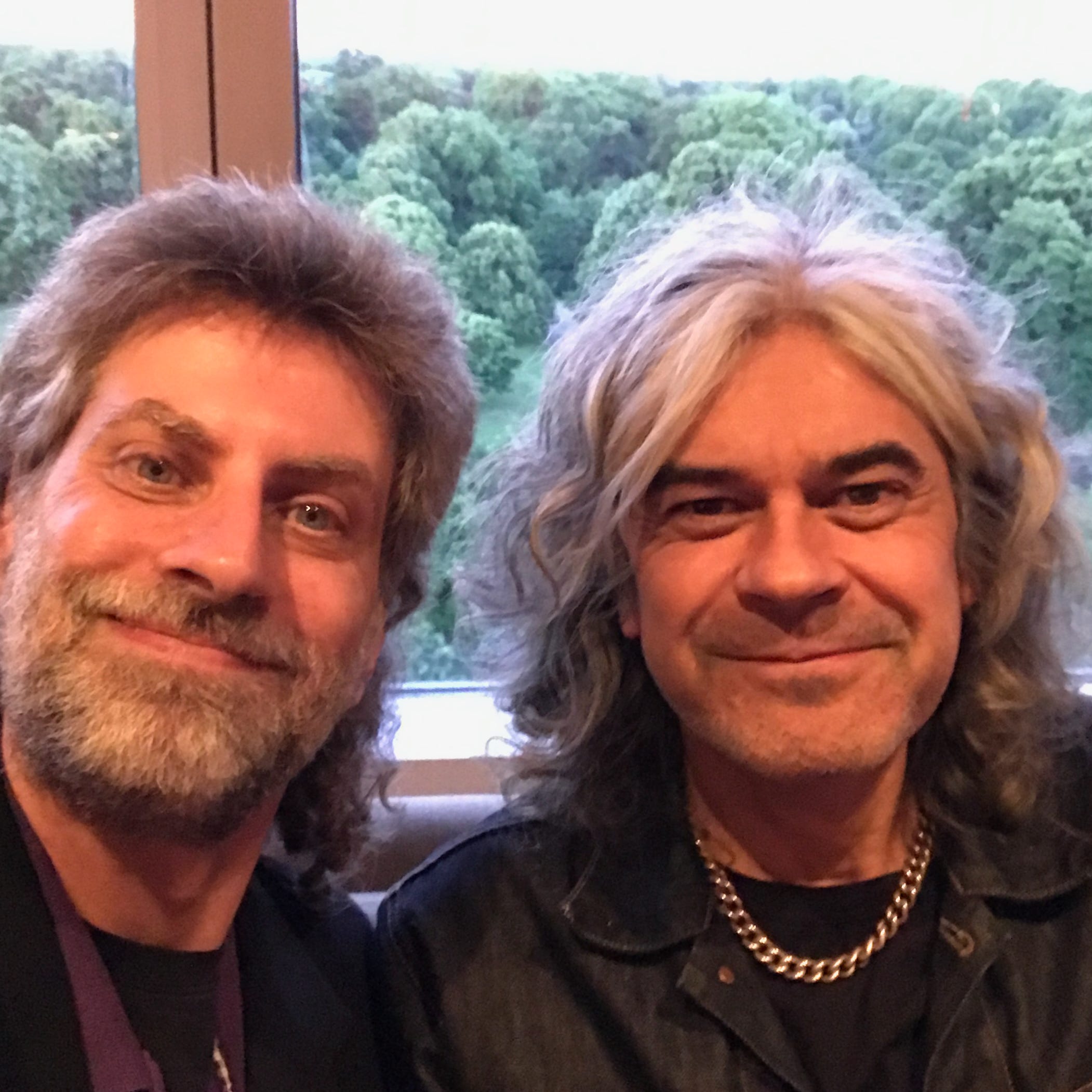
To underscore the point about authenticity and trust, I didn’t consult Matt before writing this. He has no idea I’ve done it. He’ll be reading it at the same time as everyone else. I’m writing about The People Tree because it’s one of my favorite records ever, and because years of loving it came before that phone call. The friendship is a consequence of the record, not the other way around. Consider this paragraph the return address on a virtual manila envelope.
I don’t have easy answers to problems of slop, manipulated hype, or manufactured virality. But I loathe the descent into cynicism, so I leave you with this: keep listening to the people whose names make or break the recommendation. The guy behind the counter at the record store who knows what’s missing from your collection. The historian who authors the liner notes. A webmaster who forwards a fan’s email and a musician who returns that message from across an ocean because a fan cared enough to send it. There is no trend simulation for Mother Earth.
You cannot audit an algorithm. You can audit a human. Around here, that's called a conversation.
Beyond everything personal in this piece, I believe The People Tree is a sleeping giant, an album thousands of people would love.
About that joke. Writing this piece three decades later, staring at my own list of comparisons, the Small Faces and Brian Auger's Oblivion Express sitting right there, it finally landed: a band this steeped in mod and Hammond worship had a better Brian and a better Lane on offer. A trip down memory lane with Brian Auger and Ronnie Lane, in other words, and Yes's manager likely had nothing to do with it. The year after The People Tree came out, Deighton was onstage with the actual Oblivion Express, calling it "one of the highlights of ever having picked up a guitar." So I pulled this record because of a joke the band probably never told. Joke’s on me! Matt, since you're finding all this out along with everyone else, maybe you can confirm: Which Brian? Which Lane? Or is Brian Lane a street somewhere, and there’s no joke at all?
Stunner post, Syd.
Truth is spoken here.....